
Whether you’re chasing a time you haven’t cracked yet or trying to stop the same injury wrecking another training block, the question underneath is the same: what is your running asking of your body, and how much have you actually got to give?
A Perth running assessment that measures both properly. Then we sit down with you and explain what it means in plain English — and exactly what to do next.
$450 · both sessions included

Cameras and sensors pick up what nobody can see by eye
Each leg measured on its own, so nothing hides
We test at effort, because that’s when things go wrong
A second session to go through it properly
About 90 minutes, then 30–45 a few days later
Movement camera, force plates, shoe sensors, video
Covers both sessions · private health rebates apply
Your footage and your numbers, on your phone
Exercises taught in person, not emailed
One question decides which path you’re on: is something hurting right now? Same equipment, same price, and the same clinician across both your sessions. What changes is how far we push the testing on day one, and what we focus on when you come back.
There’s one booking button. After you book, we send you a short form asking what’s going on and what you’re aiming for. We read it before you arrive and build your session around your answers.
Something hurts, or it keeps coming back every time you build up.
Typical: shin pain that returns at 40km a week. A calf that goes on every hill session. Coming back after time off, surgery, illness, or after having a baby.
You’re training well and want to know what’s holding you back, or what might break next.
Typical: training more but not getting faster. A race in the calendar you’d like to actually reach. Or you’d simply rather know than find out the hard way.
Each one picks up something the other three miss. On their own they’re numbers on a screen. Read together, they tell you what’s actually going on.
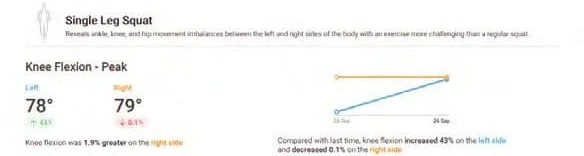
A camera watches you squat, balance and step down, and measures your joint angles as you go. Nothing to wear, nothing stuck to your skin. It catches what’s almost impossible to judge by eye — a knee drifting in, a hip dropping, one leg quietly doing less than the other.
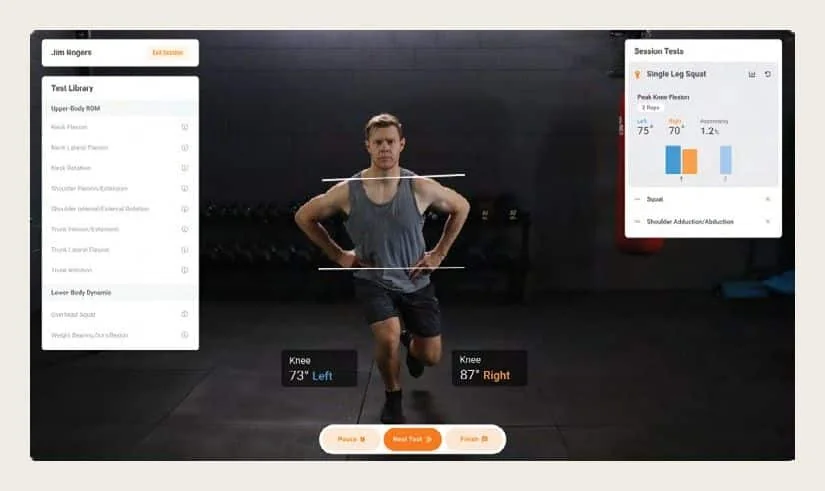
Both knees read at once. Here the right bends 14° more than the left — a difference you’d never feel.
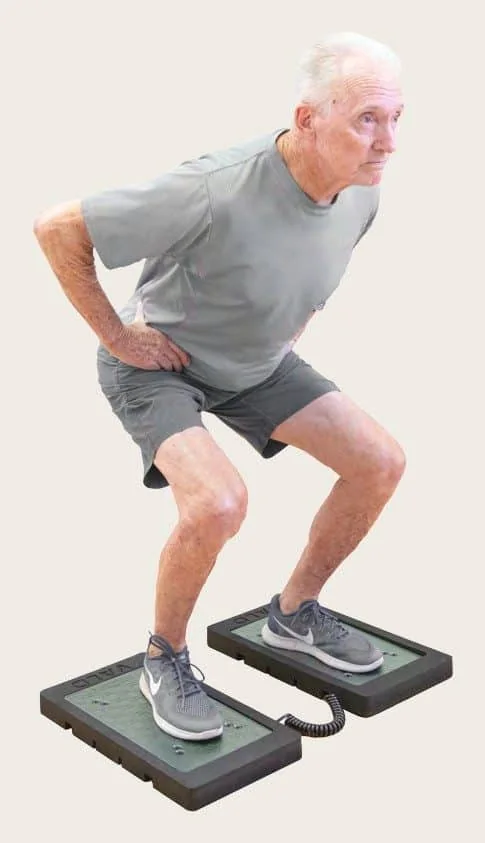
Two plates, about the size of bathroom scales, reading each leg separately. This is the half a camera can’t give you: video shows your knee falling in, but not whether that’s a weak hip, a slow calf, or a left leg doing 20% less work. Those three need three different plans.
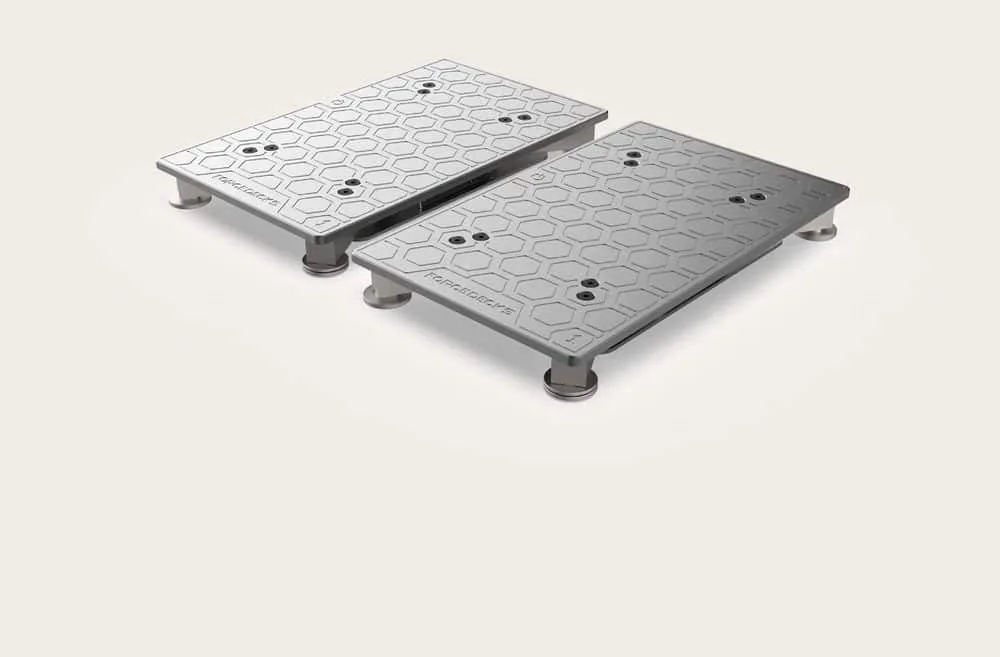
One plate under each foot, so your weaker leg can’t hide behind your stronger one.
Two sensors, each the size of a coin, clip to your laces — one per shoe, so everything comes back left and right separately. You run outside in your own shoes, not for thirty seconds on a treadmill, because what matters is what happens once you’ve started to tire.
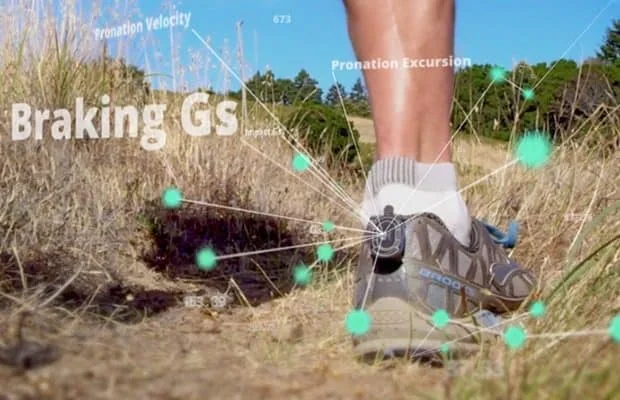
One sensor per shoe, on a real run outside. Every footstrike is measured.
Filmed from the side and behind, at an easy pace and then at effort. Video won’t measure your strength — the force plates do that. What it does better than anything is show you your own hip dropping until you can’t unsee it, and the people who change something are almost always the ones who watched themselves do it.
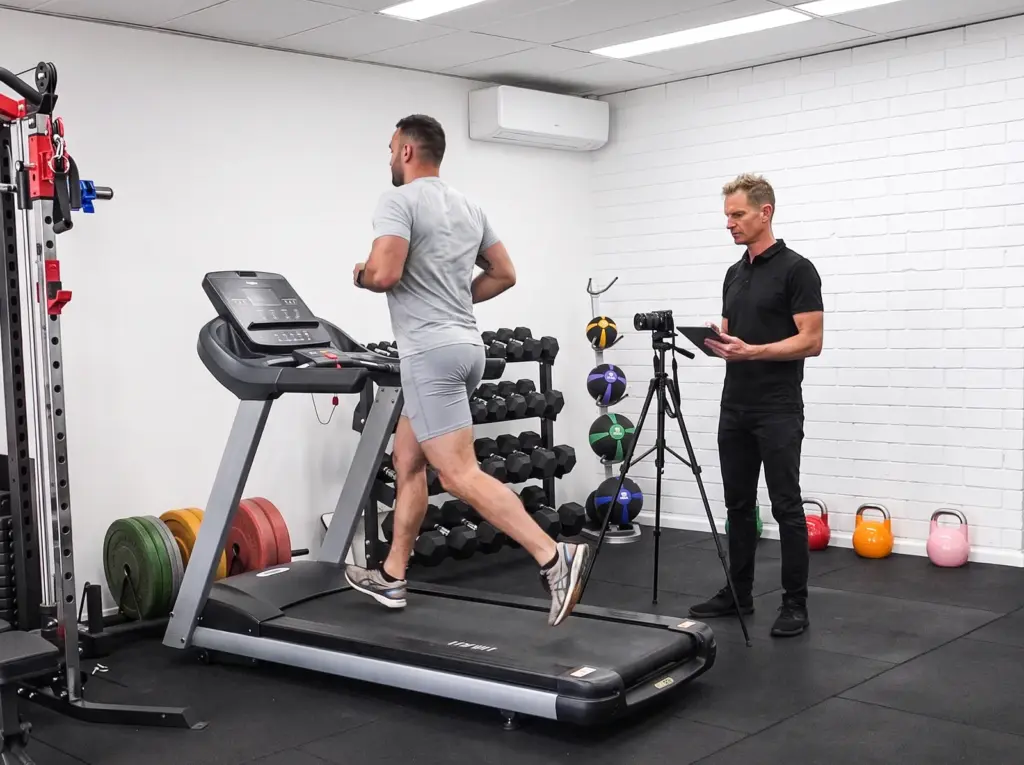
Side-on and from behind, easy pace then at effort.
No sensor is perfect, and we’d rather you heard that from us. The shoe sensors are very good at how your foot rolls and how your rhythm changes, less precise at raw impact — so we treat impact as a trend, not gospel. The force plates are excellent for comparing you to yourself over time, which is what matters for your recovery, but their numbers aren’t interchangeable with research-grade lab equipment.
Nothing here prints your answer. The equipment gathers; your clinician reads it against your training, your history and the hands-on examination. That’s the part that matters, and it’s why there’s a second session.
Most places test you, read the screen out loud while you’re putting your shoes back on, and email you a PDF you’ll skim once. We do it differently, on purpose. Working out which two things out of forty actually matter for you takes proper thought — so the first session gathers everything, and the second is where it all gets explained and turned into a plan.
Roughly 90 minutes. Come in running gear, ideally shorts, and bring every pair of running shoes you’re using.
Your training, the last twelve months, what you’ve tried, what you’re aiming at. We’ve already read your form, so this is us filling in the gaps.
Squats, balance and step-downs in front of the movement camera, so we can measure how your joints behave under load.
A few jumps and hops on the plates, and pushing against a bar for your hip, knee and ankle. Nothing heavy. If you’re injured, we keep it inside what you can handle.
How your joints move, how your tissue responds, and the specific tests for whatever’s sore. If you’re in pain, treatment often starts here.
Sensors clip to your laces, cameras go side-on and behind. Easy pace first, then at effort — because that’s when things break down.
Roughly 30–45 minutes, a few days later. Your data arrives on your phone before you come in.
Your footage slowed right down, next to your numbers. You’ll see the hip drop on screen and the matching number in the data at the same moment. This is usually when it clicks.
Not a reading of the screen. What the four sets of results say when you put them together, what’s causing your problem, and what’s just noise.
The specific exercises chosen from your test results — not a generic sheet. We do them with you, so you leave knowing how each one should feel and what you’re aiming for.
What to change in your running week, how to build back up safely, and the marks to hit before you add distance.
If you came in injured, this is also a treatment session — and a second set of numbers we can compare against your first.
Your clinician sits down with your results before you come back. Four sets of data, read against each other and against what we found with our hands. The equipment gathers the numbers. Working out what they mean is the part you’re paying for.
Every assessment at Leederville is run start to finish by the same clinician — the same person on day one, between sessions, and when you come back.

Chiropractor · MSK & Sports Injuries
Tim is an athlete and performance chiropractor with a background in sports rehabilitation, load management and complex musculoskeletal injury. He works with elite athletes through to people managing long-term pain, and every plan adapts to the person in front of him — their load tolerance, their timeline, their goals.
He is also the reason this page opens with “so do we”. An endurance runner, cyclist, swimmer and forever boogie boarder, carrying 1.5kg of titanium plates and screws after being run over by a car and rebuilding from more than 50 fractures. He has spent years doing personally what he will ask you to do: find the gap, load it progressively, then measure whether it worked.
The slow-motion clips from both angles, on your phone.
How you land, how your foot rolls, your rhythm, left compared to right.
Every result, how you compare to others your age, and the gap between your legs.
Your exercises with sets and reps, plus a summary for your coach if you want one.
There’s one booking, whether you’re injured or chasing a personal best. You tell us which on your intake form, and we build your assessment around it.
Private health rebates apply. Both sessions are billed as chiropractic consultations, so if your extras cover includes chiropractic you can claim on the spot through HICAPS and only pay the gap. You don’t need a referral from your GP.

Session one · testing
Your clinician reviews your results
Session two · results and exercises
Not sure if it’s right for you? Email us and we’ll tell you honestly.
Because the thinking is the valuable part, and it can’t be done well while you’re catching your breath. Four sets of results have to be read against each other, against your training history and against what we found with our hands — then narrowed down to the two or three things that actually matter for you. Doing that properly takes time between sessions. You also get far more out of your exercises when someone teaches them to you in person instead of emailing a PDF.
No. There’s one booking button and one price. After you book, we send you a short form asking what’s going on and what you want out of it. We read it before you arrive and plan your session from there. If you’re not sure which describes you, just say so on the form — that’s useful information in itself.
Fair question. It covers two appointments, not one, plus the time your clinician spends working through your results between them. In practical terms you’re paying for four different measurement systems, a proper diagnosis, treatment where it’s needed, a plan built off your own numbers, and a session where someone teaches you the exercises properly. If your extras cover includes chiropractic, you can claim on both sessions.
Your watch gives you one number for both legs mixed together, and it can’t measure strength at all. Our sensors sit on each shoe, so everything comes back for your left and right separately — and a difference between your two sides is one of the main reasons injuries keep returning. Your watch tells you what you did. This tells you what it cost you, and whether your body can currently afford it.
Usually not. Even if you can’t run a step, we can measure your strength, find any difference between your legs, examine you properly and send you home with a diagnosis, a plan and a clear target to hit before you start again. If you can manage a few minutes of easy running we’ll add the sensors and video too. Give us a call and we’ll tell you honestly whether to come in now or in a fortnight.
Yes — and there’s a decent argument it’s the better time. A set of starting numbers is only useful if you take it before something goes wrong. Coming in before a big training block shows where you’re most likely to break down while there’s still time to do something about it.
It shouldn’t. We read your intake form before you arrive, so if you’re injured your testing is planned around what you can handle and we stop well short of anything that would aggravate it. The strength testing is the least demanding part of the day — a few small jumps and pushing against a bar. Tell us at any point if something doesn’t feel right and we’ll adjust.
Only where there’s a clear reason, and never as the first thing we try. Most running problems are about how much you’re doing and what your body can currently handle, long before they’re about technique — and changing how you run before you’re strong enough to hold the new pattern is a good way to swap one injury for another. Where a change is genuinely worth making, we bring it in gradually alongside the strength work that supports it.
No. They help some people and are unnecessary for most. The advantage of the sensors is that we don’t have to argue about it — run the same route with and without, and compare the numbers.
Yes, all of it. Your movement results, strength results, running data and footage go to your phone and stay there. With your permission we’ll also send a one-page summary to your coach or another practitioner you’re working with.
Not necessarily. Plenty of people do the two sessions, take their plan and get on with it — that’s completely fine and it’s designed to work that way. If you’d like to see whether it worked, coming back in six to twelve weeks lets us retest and show you the actual change rather than asking you to guess from how things feel.
If your extras cover includes chiropractic, then generally yes, on both sessions, and you can claim on the spot through HICAPS so you only pay the gap. You don’t need a GP referral to book.
If we think you need imaging or a referral, we’ll say so and organise it. We’d rather tell you that on day one than sell you a plan.